
Kolkata hair transplant market is in an interesting transition phase. Fewer clinics than other metros, but consolidation is happening fast. Patients from eastern India who once flew to Delhi are increasingly trusting Kolkata senior surgeons.
Why People Choose Kolkata for a Hair Transplant
Lower competition has an under-appreciated side effect. Established Kolkata surgeons typically spend more time per consultation than their NCR counterparts. The volume pressure is lower, so the patient experience tends to be calmer and more thorough.
Salt Lake, Park Street, Camac Street, and Ballygunge are the main clinic areas. Many North-East and Bihar patients consolidate to Kolkata. Pricing is meaningfully lower than other metros.
Hair Transplant Cost in Kolkata
The numbers below are approximate market ranges for Kolkata as of 2026. Pricing varies meaningfully between clinic tiers, and what you actually pay depends on the surgeon performing the extraction, the technique, and the inclusions in the package.
| Graft Count | Typical Use Case | Approximate Cost |
|---|---|---|
| 1,500 grafts | Early hairline restoration (Norwood 2) | Rs 45,000 - Rs 1,28,000 |
| 2,000 grafts | Hairline + mid-scalp (Norwood 3) | Rs 60,000 - Rs 1,70,000 |
| 3,000 grafts | Hairline + crown (Norwood 4) | Rs 90,000 - Rs 2,55,000 |
| 4,000+ grafts | Advanced cases (Norwood 5+) | Rs 1,20,000 - Rs 3,82,000 |
What to Check Before Choosing a Clinic in Kolkata
Before you commit to any clinic, work through this checklist. Most of these can be verified in 10 minutes of conversation with the consultant, and the answers tell you more than any before-after photo.
- Who will perform the slit creation and graft extraction? Get this in writing - the surgeon, not a technician. Slit angle and depth are the two highest-skill steps of any transplant.
- Will the surgeon meet you in person before surgery day? A 5-minute hello in the operating room is not a consultation. You need a proper pre-op discussion.
- Ask to see at least 5 unedited 12-month patient results. Not just the clinic best-case marketing photos. Request varied cases (different graft counts, different starting points).
- Confirm the exact graft count plan. Get a range like 2,200 to 2,400 grafts, not a vague around 2,500. Final count affects price, donor preservation, and result density.
- Ask about post-op care and follow-ups. What is included, what is extra. PRP and GFC sessions are commonly upsold post-surgery. Clarify in advance.
- What is the plan for your native hair? A transplant only treats the transplanted zone. Native hair around it can continue to fall. Ask about Finasteride and Minoxidil recommendations.
- What if the result is below expectation? Established clinics will discuss revision or touch-up policies. The conversation itself tells you something about the clinic culture.
FUE vs FUT - Which Suits You
The technique choice matters less than people think. Surgeon skill matters more. But the two techniques do serve different cases, so it is worth understanding the distinction.
FUE (Follicular Unit Extraction): Individual follicular units extracted using a small punch. No linear scar, faster recovery (7-10 days), but more expensive per graft. Suits most modern patients, especially anyone wanting to wear hair short, anyone with a graft requirement under 3,000, and anyone whose donor area allows it.
FUT (Follicular Unit Transplantation / Strip): A strip of donor skin removed, dissected under microscopes, then transplanted. Leaves a linear scar (typically hidden by hair longer than grade 3), longer recovery (14-21 days), but allows higher graft counts in one session (up to 4,000-4,500). Still relevant for advanced Norwood 5-7 cases needing maximum donor yield.
For most Kolkata patients in the Norwood 2-4 range, FUE is the natural choice. For advanced cases, ask a Kolkata surgeon experienced in both. Many have stopped doing FUT entirely, which can limit your options.
Patient Journey - Real Results
Below are sample patient outcomes from the Kolkata ecosystem. Each transplant is a unique case, these are representative, not guaranteed outcomes.
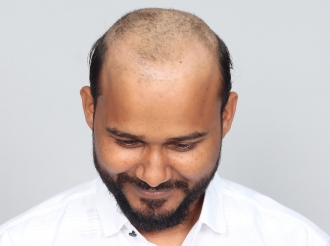
Pre-op scalp, Norwood 3

Immediate post-op (Day 1)
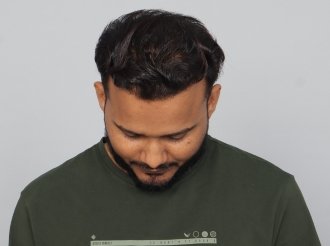
6-12 months results
Planning a hair transplant in Kolkata?
Message me directly on WhatsApp. I read every message personally - honest opinion, no clinic affiliation.