
Gurgaon represents NCR premium tier. Corporate executive patient base, latest equipment, glass-and-steel clinic chains, and pricing meaningfully above core Delhi. For some patients the convenience is worth it, for others it is not.
Why People Choose Gurgaon for a Hair Transplant
Gurgaon clinics tend to invest heavily in patient experience. Appointment punctuality, modern interiors, English-first communication, professional support staff. The surgeon talent overlaps significantly with South Delhi clinics.
Cyber Hub, MG Road, Golf Course Road, and Sushant Lok are the main clinic clusters. Many surgeons split practice between Gurgaon and South Delhi. Patient base is heavily NCR corporate.
Hair Transplant Cost in Gurgaon
The numbers below are approximate market ranges for Gurgaon as of 2026. Pricing varies meaningfully between clinic tiers, and what you actually pay depends on the surgeon performing the extraction, the technique, and the inclusions in the package.
| Graft Count | Typical Use Case | Approximate Cost |
|---|---|---|
| 1,500 grafts | Early hairline restoration (Norwood 2) | Rs 75,000 - Rs 2,25,000 |
| 2,000 grafts | Hairline + mid-scalp (Norwood 3) | Rs 1,00,000 - Rs 3,00,000 |
| 3,000 grafts | Hairline + crown (Norwood 4) | Rs 1,50,000 - Rs 4,50,000 |
| 4,000+ grafts | Advanced cases (Norwood 5+) | Rs 2,00,000 - Rs 6,75,000 |
What to Check Before Choosing a Clinic in Gurgaon
Before you commit to any clinic, work through this checklist. Most of these can be verified in 10 minutes of conversation with the consultant, and the answers tell you more than any before-after photo.
- Who will perform the slit creation and graft extraction? Get this in writing - the surgeon, not a technician. Slit angle and depth are the two highest-skill steps of any transplant.
- Will the surgeon meet you in person before surgery day? A 5-minute hello in the operating room is not a consultation. You need a proper pre-op discussion.
- Ask to see at least 5 unedited 12-month patient results. Not just the clinic best-case marketing photos. Request varied cases (different graft counts, different starting points).
- Confirm the exact graft count plan. Get a range like 2,200 to 2,400 grafts, not a vague around 2,500. Final count affects price, donor preservation, and result density.
- Ask about post-op care and follow-ups. What is included, what is extra. PRP and GFC sessions are commonly upsold post-surgery. Clarify in advance.
- What is the plan for your native hair? A transplant only treats the transplanted zone. Native hair around it can continue to fall. Ask about Finasteride and Minoxidil recommendations.
- What if the result is below expectation? Established clinics will discuss revision or touch-up policies. The conversation itself tells you something about the clinic culture.
FUE vs FUT - Which Suits You
The technique choice matters less than people think. Surgeon skill matters more. But the two techniques do serve different cases, so it is worth understanding the distinction.
FUE (Follicular Unit Extraction): Individual follicular units extracted using a small punch. No linear scar, faster recovery (7-10 days), but more expensive per graft. Suits most modern patients, especially anyone wanting to wear hair short, anyone with a graft requirement under 3,000, and anyone whose donor area allows it.
FUT (Follicular Unit Transplantation / Strip): A strip of donor skin removed, dissected under microscopes, then transplanted. Leaves a linear scar (typically hidden by hair longer than grade 3), longer recovery (14-21 days), but allows higher graft counts in one session (up to 4,000-4,500). Still relevant for advanced Norwood 5-7 cases needing maximum donor yield.
For most Gurgaon patients in the Norwood 2-4 range, FUE is the natural choice. For advanced cases, ask a Gurgaon surgeon experienced in both. Many have stopped doing FUT entirely, which can limit your options.
Patient Journey - Real Results
Below are sample patient outcomes from the Gurgaon ecosystem. Each transplant is a unique case, these are representative, not guaranteed outcomes.
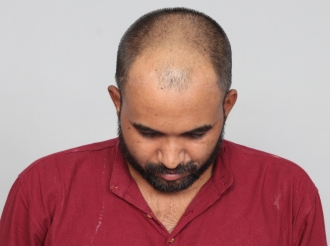
Pre-op scalp, Norwood 3
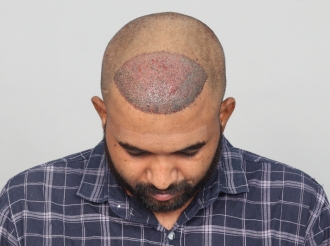
Immediate post-op (Day 1)
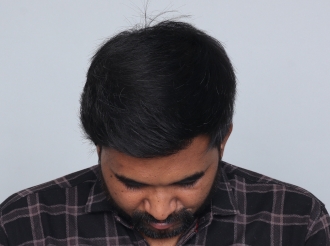
6-12 months results
Planning a hair transplant in Gurgaon?
Message me directly on WhatsApp. I read every message personally - honest opinion, no clinic affiliation.