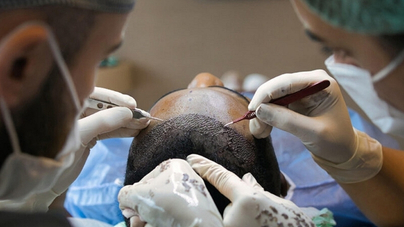
Every clinic in India presents the three techniques as if they're fundamentally different products — FUE the modern miracle, FUT the outdated relic, DHI the premium "next generation". The truth is much simpler. Two of them are essentially the same technique with different tools, and one of them is still the best option for a small but important group of patients. Here's the honest breakdown.
FUE — Follicular Unit Extraction
Individual follicular units (groups of 1–4 hairs growing from one pore) are extracted one at a time from the donor zone using a 0.7–1.0 mm motorized punch. Each graft is then placed into pre-made recipient slits using fine forceps.
Strengths:
- No linear scar — only tiny dot scars in donor (invisible under hair)
- Faster healing — back to work in 5–7 days
- Can pick body hair as donor in extreme cases
- Suitable for patients who keep short hair
Weaknesses:
- Slower extraction — caps around 3500–4000 grafts/day
- Higher cost per graft (Rs.40–Rs.150)
- Can over-extract donor if surgeon is greedy — visible thinning
FUT — Follicular Unit Transplantation
A strip of skin (roughly 1 cm wide × 15–20 cm long) is surgically removed from the donor zone, sutured closed, and then dissected under microscope into individual follicular units. These are then placed into recipient slits.
Strengths:
- Higher single-session graft yield — 3500–4500 in one day
- Cheaper per graft (Rs.25–Rs.80)
- Preserves donor density better in long term (less surface scarring)
- Better for very large NW5/NW6 cases
Weaknesses:
- Linear scar (3–5 mm wide) in donor — visible if hair is shaved below grade 3
- Longer recovery — 10–14 days for sutures + healing
- Not suitable for patients who plan to keep shaved heads
DHI — Direct Hair Implantation
Same FUE extraction in the donor. The only real difference: instead of pre-making recipient slits and then placing grafts with forceps, the surgeon uses a Choi implanter pen that creates the slit and inserts the graft in one motion.
Strengths:
- Allows transplantation without shaving the recipient zone (great for women, beards, eyebrows)
- Slightly more precise control of angle and depth
- Reduces graft handling — marginally better survival in theory
Weaknesses:
- 20–30% more expensive than FUE
- Slower placement — caps single-session count lower than FUE
- Real-world results identical to a well-done FUE
- Heavily over-marketed as if it's a different technology — it isn't
Side-by-side comparison table
| Factor | FUE | FUT | DHI |
|---|---|---|---|
| Donor scar | Tiny dots | Linear scar | Tiny dots |
| Max grafts/day | ~3500–4000 | ~4500 | ~2500–3000 |
| Cost per graft | Rs.40–150 | Rs.25–80 | Rs.55–180 |
| Recovery time | 5–7 days | 10–14 days | 5–7 days |
| Shave recipient? | Usually yes | Yes | Optional |
| Suits short hair | Yes | No | Yes |
| Suits long native hair | Possible | Yes | Best |
| Best for NW | NW2–NW5 | NW5–NW6 | NW2–NW4 |
| Survival rate* | 85–95% | 85–95% | 85–95% |
*With equally experienced surgeon. The label barely matters — the surgeon matters 10x more.
Who should pick which?
Pick FUE if:
- You're NW2–NW5 with adequate donor
- You keep short hair (or might shave in future)
- You want faster recovery
- Standard default for most patients
Pick FUT if:
- You're NW5–NW6 needing maximum single-session yield
- You keep medium-to-long hair (scar hidden)
- You prefer to preserve donor for future revisions
- Budget is tighter
Pick DHI if:
- You want to skip the recipient shave (work, social reasons)
- You're getting eyebrow, beard, or female hair transplant
- Cost difference doesn't matter to you
- Your NW is low (NW2–NW4) — high-graft DHI sessions are slow
Marketing terms you can safely ignore
- Sapphire FUE: Sapphire-blade slits instead of steel. Marginal smoothness benefit. Don't pay 25% more for it.
- Bio-FUE / Ultra-FUE: Standard FUE + PRP boost. PRP is good but is a separate service that can be added to any technique.
- Robotic FUE (ARTAS): Robot-assisted extraction. Slightly faster, slightly less accurate than top human surgeons. India has very few real ARTAS units — most "robotic" claims are marketing.
- Stem cell hair transplant: No stem cells are actually transplanted. Marketing for PRP/exosomes adjunct.
- "Painless" technique: All techniques use local anaesthesia. The anaesthesia injection is the only painful part — and it's the same across techniques.
My honest recommendation
For 80% of patients I speak to, well-done FUE is the right answer. It's the most flexible, has the cleanest aesthetic recovery, and matches what 85% of Indian clinics actually do well.
For NW5/NW6 with stable hair loss and medium hair length, FUT delivers more grafts at lower cost — worth considering with a surgeon who still does FUT well (becoming rare).
For DHI, the only patients I genuinely recommend it to are women, beard/eyebrow restoration patients, or people who can't take 2 weeks off and need to skip the recipient shave. Otherwise the 25% extra cost goes to marketing, not better results.
The technique name on the brochure means very little. The surgeon's name and track record means almost everything. Pick the surgeon first, then let them pick the technique.
Frequently Asked Questions
Is DHI better than FUE?
DHI is essentially FUE done with a Choi implanter pen instead of forceps and slits. Final results are nearly identical. DHI's only real advantage is implantation into existing hair without shaving.
Which technique gives the most grafts in one session?
FUT can deliver the largest single-session count, often 3500 to 4500 grafts. FUE caps around 3500–4000.
Does DHI cause less scarring than FUE?
Both use punch extraction in the donor — scarring is identical at the donor zone. The Choi pen affects implantation only.
Is FUT outdated?
Not outdated, just less popular due to the linear scar. Still the best for very large NW5–NW6 cases.
Which technique has higher graft survival?
With equally experienced surgeon, all three deliver 85–95% survival. Surgeon skill matters more than technique label.
Disclaimer: Sahil Ayyan is not a doctor. This article shares experience-based observations and does not replace medical consultation. Always confirm technique choice with a qualified hair transplant surgeon. Junaid Aalam and Shahil Ayyan is a registered trade name of Sahil.
Want a personal recommendation for your case?
Send a scalp photo and your goals on WhatsApp. I'll suggest the technique and 3 surgeons in your city who do that technique well — honestly, no kickback.
WhatsApp Sahil
Sahil Ayyan
Hair transplant guidance based on personal experience. I share what I learned the hard way. Read my full journey →